|
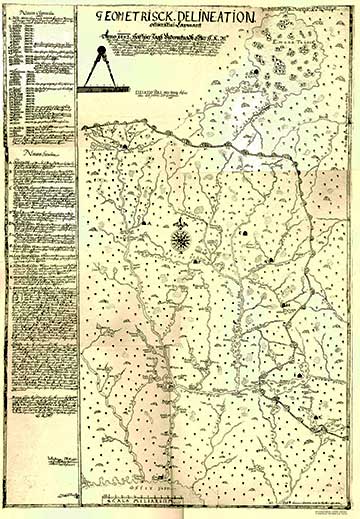
MAP OF KEMI LAPLAND OF 1642The names of places on the eastern border of Kemi Lapland have been printed on the map in numerical order (Notatio cyphrarum) and the explanatory text is displayed in alphabetical order (Notatio literarum). Notatio Literarum: B. The village of Peltojärvi. The Lappish people who earlier lived and kept their market here nowadays pay their taxes in the village of Markkina in Tornio Lapland, yet they continue to hunt for game and fish in these areas as they have done earlier. C. The village of Inari is located on the northern side of the fell ridge of Lake Inarijärvi. It will move approximately ten kilometres from its present location as the timber and reindeer lichen are depleting. The village area has excellent fishing grounds, good wild reindeer grounds and average beaver rivers. The village pays its taxes to Sweden, Norway and Russia and is one of Sweden's largest and best Lappish villages. D. The Inari Lapps wish to move their village to this peninsula. This indeed is the most picturesque location for a church one could imagine, as is evident from the map. E. The village of Sompio taxed by Sweden and Russia. Good beaver rivers and reindeer stock, but poor fishing grounds. Consequently, the people of Sompio mainly purchase fish from the Inari Lapps. F. The Sodankylä village is taxed by Sweden and Russia. Good fishing and wild reindeer grounds and the best beaver stock of all Sweden's Lappish villages including the village of Sompio. G. The Keminkylä village is taxed by Sweden and Russia. Good wild reindeer grounds and fishing areas but minor beaver stock. H. The village of Kuolajärvi is taxed by Sweden and Russia. Good hunting grounds and fisheries, and a modest beaver stock. I. The village of Kitkajärvi taxed by Sweden and Russia is a small and poor Lappish village, primarily earning livelihood from fishing. Good fishing grounds but minor wild reindeer grounds and no beavers at all. K. Maanselkä, a small and poor village where Lappish families residing here mainly receive livelihood from fishing, few wild reindeer, no beavers. L. This area in the upper regions of Lake Kemijärvi is an excellent church location as it is picturesque and low-lying and because of good availability of firewood, good fishing grounds and good lichen land, good availability of timber, and because during the summer months one can navigate along the waterway routes from here to the Sompio, Sodankylä, Keminkylä, Kuolajärvi and Kitkajärvi villages. The wintertime distances from these localities to Kemijärvi are also not greater than the summertime distances. The Pirkanmaa people and many others wanting to trade here can easily arrive from the Gulf of Bothnia to see what is available at the marketplace. The Russians easily sail along the rivers and draw them over the necks of land. They are able to easily navigate the waterways to the Church of Kemi, the sea and to almost all the Kemi Lapland villages. In addition, Kemi Lapland is the most distant even-lying area of the five areas of Sweden's Lapland. There is an abundance of bogs, few mountains, beautiful forests and many rivers easy to navigate as the rapid water sections may be navigated here due to them being less fierce compared to other parts of Lapland. People residing here are diligent and industrious, consequently the best quality and majority of Lappish ware in Sweden, Norway and Russia originates from this region. They have an enthusiasm to learn and they are indeed rather well familiar with the articles of faith. The majority of adults are capable of reading the parts of the Christian doctrine in Finnish, which is the most common language for the area. The young people hold hope for more churches and for the Word of God to be preached in the neighbourhood, however, older people fear that such would bring about additional burdens. |

|
1643
|


